

Indian teacher Rouble Nagi wins $1m Global Teacher Prize at World Governments Summit in Dubai
Murals, community spaces turned into open-air classrooms across underserved neighbourhoods
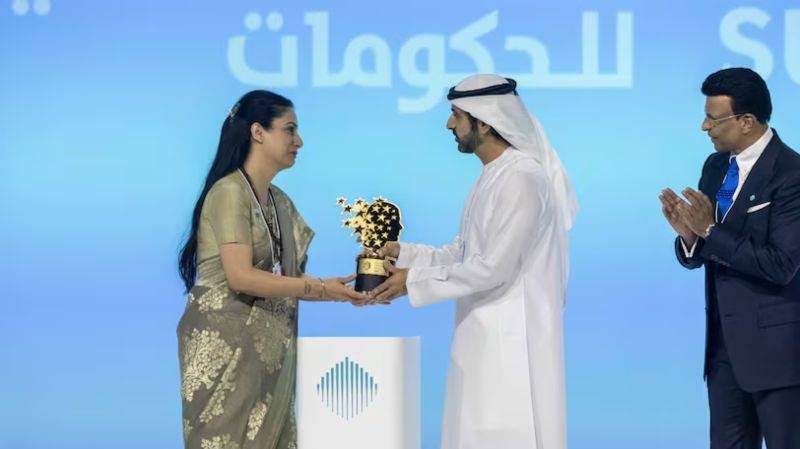
DUBAI – An Indian teacher known for transforming slum neighbourhoods into open-air classrooms has been awarded the $1 million Global Teacher Prize 2026 at the World Governments Summit in Dubai.
Rouble Nagi, an art and social science educator from Mumbai, received the honour for her large-scale, art-led education initiatives targeting marginalised and excluded children. Her work spans urban slums and remote rural areas across India, blending creativity with foundational learning and life skills.
The award was presented by His Highness Sheikh Hamdan bin Mohammed bin Rashid Al Maktoum, Crown Prince of Dubai, Deputy Prime Minister and Minister of Defence, alongside Sunny Varkey, founder of GEMS Education and the Varkey Foundation, which runs the prize in partnership with UNESCO.
The Global Teacher Prize recognises educators whose impact extends beyond traditional classrooms and produces measurable social change.
Learning movement
Nagi has spent more than two decades building community-based learning systems through Misaal India and the Rouble Nagi Art Foundation. Her programmes use art as a gateway to literacy, confidence-building and social awareness for children who often fall outside formal schooling structures.
According to reported figures, her movement has established more than 800 learning centres and mobilised around 600 volunteers and paid teachers. These centres operate in slums and underserved rural regions, offering low-cost, accessible education models designed to reduce dropout rates and improve long-term engagement. Across multiple projects, her initiatives have reached more than one million children through education access, skills development and creative training.
One of her most recognised concepts is the “Living Walls of Learning” model, where neighbourhood walls, lanes and courtyards are painted with educational murals. These function as permanent visual textbooks for entire communities, allowing children to learn from their surroundings even outside structured class hours. The approach integrates academic basics with creative expression and vocational exposure.
Community impact
Beyond classroom-style teaching, Nagi’s work includes large-scale neighbourhood transformation drives. Her Misaal Mumbai project is described as India’s first slum-transformation initiative. Under the project, more than 155,000 houses were painted, while sanitation and waterproofing improvements were carried out. Hygiene workshops and community awareness sessions were also organised alongside visual upgrades.
Through the Misaal India programme, run under her foundation, art-based and activity-driven education has been delivered across more than 100 slums and villages. These programmes focus not only on literacy and numeracy but also on life skills, confidence, health awareness and practical exposure. The model aims to build agency and aspiration among children growing up in high-risk and low-resource environments.
Her educational philosophy combines creative arts with structured social science learning, encouraging children to engage with their environment while developing practical knowledge. Many of the centres also introduce basic vocational pathways and skill-building modules to help older children explore income-linked abilities.
Global Teacher Prize
Now in its tenth year, the Global Teacher Prize has received more than 100,000 nominations worldwide. It highlights educators whose work produces sustained impact in their communities and demonstrates scalable models for inclusive education. The $1 million prize is funded by GEMS Education.
Surrounded by the educators who stood beside her throughout this journey ????
— Global Teacher Prize (@TeacherPrize) February 5, 2026
Rouble Nagi, the 10th winner of the 2026 GEMS Education Global Teacher Prize, pictured with her fellow Top 10 finalists. A moment of shared pride, solidarity and respect among teachers whose work… pic.twitter.com/SlCitM2Zzy
During remarks shared in earlier statements, Nagi described the recognition as motivation to expand her outreach further. She said the award strengthens her mission to reach more children, remove access barriers and ensure learners not only enter education systems but continue and succeed within them. She has also spoken about travelling across some of India’s most remote regions and witnessing first-hand the number of children still outside school networks.
In her public comments, she has emphasised equal access to education for both girls and boys, calling schooling the most valuable gift that can be given to a child. She has repeatedly linked her work to social responsibility and grassroots service.
Last year’s Global Teacher Prize winner was Mansour bin Abdullah Al-Mansour from Saudi Arabia. He was recognised for contributing more than 3,000 volunteer hours to community service, including programmes supporting gifted orphans and prisoners, and for delivering educational support initiatives across vulnerable groups.
The 2026 award places a spotlight on art-driven, community-embedded learning models and large-scale volunteer mobilisation, with organisers highlighting the role of educators in shaping social mobility and inclusive development across underserved populations.